Koninklike Seël van Hiskia
Beskrywing
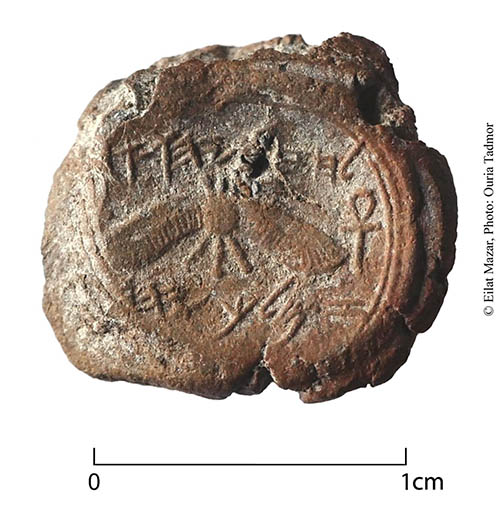
Die koninklike seël van koning Hiskia in die Bybel is gevind tydens 'n argeologiese opgrawing. Die gestempelde kleiseël, ook bekend as 'n bulla, is ontdek in die Ofel-opgrawings gelei deur Dr. Eilat Mazar aan die voet van die suidelike muur van die Tempelberg in Jerusalem. Die ontdekking is aangekondig in 'n persverklaring deur die Hebreeuse Universiteit van Jerusalem se Instituut vir Argeologie, onder wie se beskerming die opgrawings uitgevoer is.
Die bulla, wat net meer as 'n sentimeter in deursnee meet, dra 'n seëlafdruk wat 'n tweevlerk sonneskyf uitbeeld, geflankeer deur ankh-simbole en 'n Hebreeuse inskripsie bevat wat lees: "Behoort aan Hiskia, (seun van) Agas, koning van Juda." Die bulla is ontdek saam met 33 ander gestempelde bullae tydens nat sif van grond uit 'n vullishoop langs 'n 10de-eeu v.C.E. koninklike gebou in die Ofel.
In die ou Nabye Ooste is kleibullae gebruik om die toue vas te maak wat om opgerolde dokumente gebind was. Die bullae is gemaak deur 'n seël op 'n nat klomp klei te druk. Die gestempelde bulla het gedien as beide 'n handtekening en as 'n manier om die egtheid van die dokumente te verseker.
skakels
prente
Kaart
inligting uit woordeboek
Hezekiah
whom Jehovah has strengthened.
Son of Ahaz (2Kings 18:1; 2Chr 29:1), whom he succeeded on the throne of the kingdom of Judah. He reigned twenty-nine years (B.C. 726-697). The history of this king is contained in (2Kings 18:20; Isa 36:1etc.; 37:1etc.; 38:1etc.; 39:1etc.), and (2Chr 29:1etc.; 30:1etc.; 31:1etc.; 32:1etc.). He is spoken of as a great and good king. In public life he followed the example of his great-granfather Uzziah. He set himself to abolish idolatry from his kingdom, and among other things which he did for this end, he destroyed the "brazen serpent," which had been removed to Jerusalem, and had become an object of idolatrous worship (Num 21:9 ). A great reformation was wrought in the kingdom of Judah in his day (2Kings 18:4; 2Chr 29:3-36).
On the death of Sargon and the accession of his son Sennacherib to the throne of Assyria, Hezekiah refused to pay the tribute which his father had paid, and "rebelled against the king of Assyria, and served him not," but entered into a league with Egypt (Isa 30:1etc.; 31:1etc.; 36:6-9). This led to the invasion of Judah by Sennacherib (2Kings 18:13-16), who took forty cities, and besieged Jerusalem with mounds. Hezekiah yielded to the demands of the Assyrian king, and agreed to pay him three hundred talents of silver and thirty of gold (2Kings 18:14).
But Sennacherib dealt treacherously with Hezekiah (Isa 33:1), and a second time within two years invaded his kingdom (2Kings 18:17; 2Chr 32:9; Isa 36:1etc.). This invasion issued in the destruction of Sennacherib's army. Hezekiah prayed to God, and "that night the angel of the Lord went out, and smote in the camp of the Assyrians 185,000 men." Sennacherib fled with the shattered remnant of his forces to Nineveh, where, seventeen years after, he was assassinated by his sons Adrammelech and Sharezer (2Kings 19:37). (See SENNACHERIB)
The narrative of Hezekiah's sickness and miraculous recovery is found in (2Kings 20:1; 2Chr 32:24; Isa 38:1). Various ambassadors came to congratulate him on his recovery, and among them Merodach-baladan, the viceroy of Babylon (2Chr 32:23; 2Kings 20:12). He closed his days in peace and prosperity, and was succeeded by his son Manasseh. He was buried in the "chiefest of the sepulchres of the sons of David" (2Chr 32:27-33). He had "after him none like him among all the kings of Judah, nor any that were before him" (2Kings 18:5). (See ISAIAH)
EBD - Easton's Bible Dictionary