Théby
Odkazy
Street View
Obrázky
Artefakty
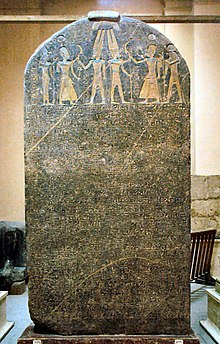
Merenptahova stéla
Merneptah stéla, také známá jako Izraelská stéla nebo Vítězná stéla z Merneptahu, je nápis Merneptaha, faraona ve starověkém Egyptě, který vládl v letech 1213 až 1203 před naším letopočtem. Objevil jej Flinders Petrie v Thébách v roce 1896 a nyní je umístěn v Egyptském muzeu v Káhiře.
Text je z velké části popisem vítězství Merneptahu nad starověkými Libyjci a jejich spojenci, ale poslední tři z 28 řádků pojednávají o samostatném tažení do Kanaánu, který byl tehdy součástí egyptského císařského majetku. Někdy je označována jako „Izraelská stéla“, protože většina učenců překládá sadu hieroglyfů v řádku 27 jako „Izrael“. Alternativní překlady byly pokročilé, ale nejsou široce přijímány.
Stéla představuje nejstarší textový odkaz na Izrael a jediný odkaz ze starověkého Egypta. Je to jeden ze čtyř známých nápisů z doby železné, které se datují do doby a jmenovitě zmiňují starověký Izrael, přičemž ostatní jsou stéla Mesha, stéla Tel Dan a monolity Kurkh. V důsledku toho někteří považují Merneptah Stele za Petrieho nejslavnější objev, s názorem, se kterým Petrie sám souhlasil.
Wikipdia
Mapa
Informace ze slovníku
kdysi hlavní město v Horním Egyptě, ležící na obou březích Nilu a známé pod jménem Théby [= Veset] nebo také Diopolis Magna. Amon jest jméno hlavního božstva thébského. Velekněz Amonův byl od 14. stol. druhým po faraónovi a dovedl se velmi účinně vzepříti monotheistické reformě, podporované faraónem Amenhotepem IV. a kněžstvem města On [viz o tom Bič II., 179 a beletristicky v knize Thomase Manna, Josef Živitel]. Město zůstalo střediskem egyptské civilisace a moci až do doby, kdy Esarchaddon [680-668], král assyrský, učinil r. 671 př. Kr. první nájezd na Egypt, a po něm jeho nástupce Asurbanipal r. 667 znovu, až bylo No r. 663 př. Kr. vypleněno [Na 3,8 ]. Přesto zůstalo i pak důležitým městem [Jr 46,25 ; Ez 30,14 - Ez 30,16 ], dokud nebylo úplně vyvráceno římským prefektem Korneliem Galiem r. 30-29 př. Kr. U městeček Luxoru a Karnaku byly nalezeny rozsáhlé zříceniny tohoto města. No Amon znamená česky dům Amonův.
Zdroj: Biblický slovník (Adolf Novotný - 1956)
No
or No-A'mon, the home of Amon, the name of Thebes, the ancient capital of what is called the Middle Empire, in Upper or Southern Egypt. "The multitude of No" (Jer 46:25 ) is more correctly rendered, as in the Revised Version, "Amon of No", i.e., No, where Jupiter Amon had his temple. In (Ezek 30:14 ; 30:16) it is simply called "No;" but in (Ezek 30:15 ) the name has the Hebrew Hamon prefixed to it, "Hamon No." This prefix is probably the name simply of the god usually styled Amon or Ammon. In (Nah 3:8 ) the "populous No" of the Authorized Version is in the Revised Version correctly rendered "No-Amon."
It was the Diospolis or Thebes of the Greeks, celebrated for its hundred gates and its vast population. It stood on both sides of the Nile, and is by some supposed to have included Karnak and Luxor. In grandeur and extent it can only be compared to Nineveh. It is mentioned only in the prophecies referred to, which point to its total destruction. It was first taken by the Assyrians in the time of Sargon (Isa 20:1etc.). It was afterwards "delivered into the hand" of Nebuchadnezzar and Assurbani-pal (Jer 46:25 ; 46:26). Cambyses, king of the Persians (B.C. 525), further laid it waste by fire. Its ruin was completed (B.C. 81) by Ptolemy Lathyrus. The ruins of this city are still among the most notable in the valley of the Nile. They have formed a great storehouse of interesting historic remains for more than two thousand years.
"As I wandered day after day with ever-growing amazement amongst these relics of ancient magnificence, I felt that if all the ruins in Europe, classical, Celtic, and medieval, were brought together into one centre, they would fall far short both in extent and grandeur of those of this single Egyptian city." Manning, The Land of the Pharaohs.
EBD - Easton's Bible Dictionary