Louvre
Links
Artifacts
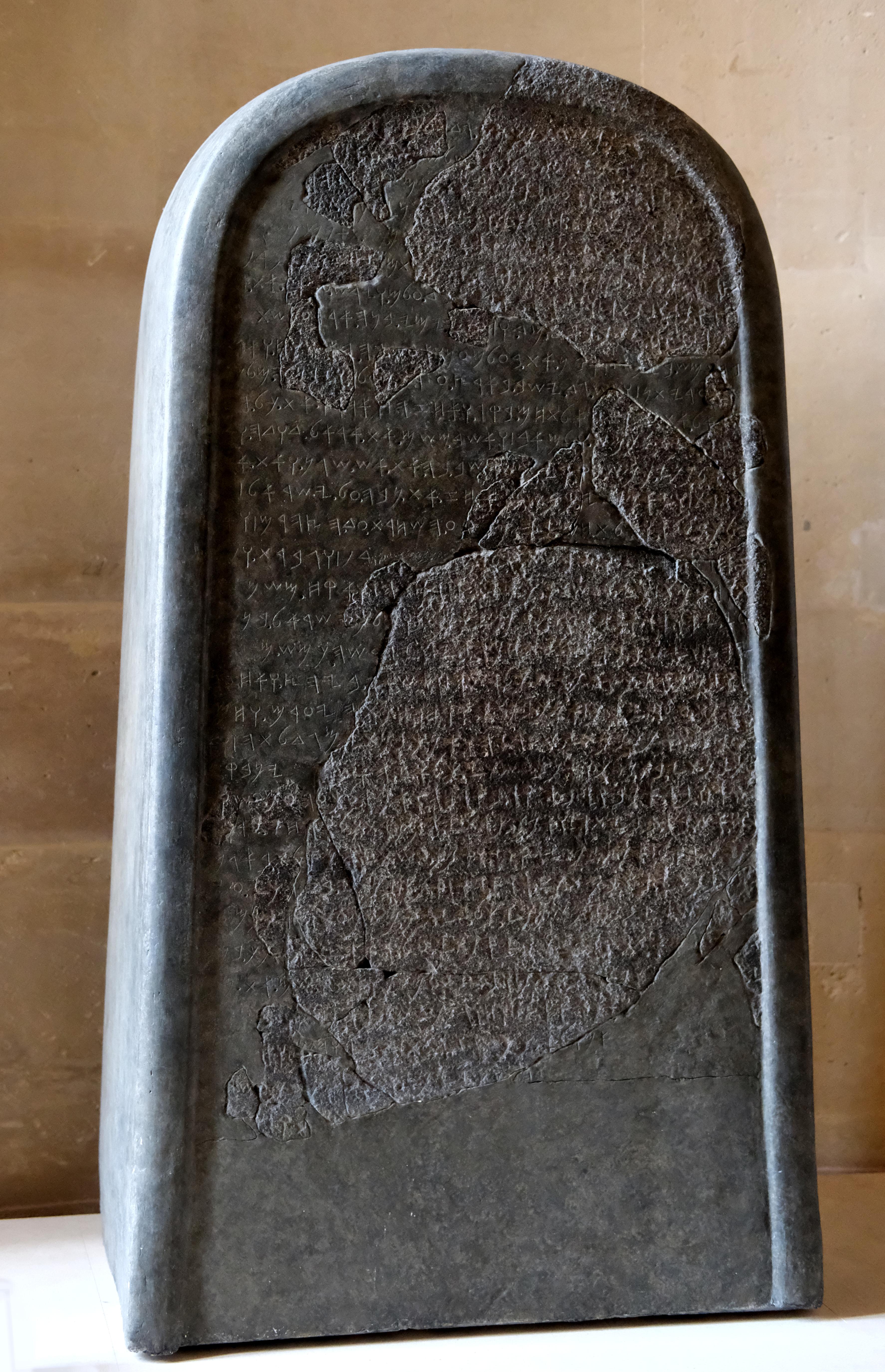
Mesha Stele
The Mesha Stele, also known as the Moabite Stone, is a stele dated around 840 BCE containing a significant Canaanite inscription in the name of King Mesha of Moab (a kingdom located in modern Jordan). Mesha tells how Chemosh, the god of Moab, had been angry with his people and had allowed them to be subjugated to the Kingdom of Israel, but at length, Chemosh returned and assisted Mesha to throw off the yoke of Israel and restore the lands of Moab. Mesha also describes his many building projects. It is written in a variant of the Phoenician alphabet, closely related to the Paleo-Hebrew script.
The stone was discovered intact by Frederick Augustus Klein, an Anglican missionary, at the site of ancient Dibon (now Dhiban, Jordan), in August 1868. A "squeeze" (a papier-mâché impression) had been obtained by a local Arab on behalf of Charles Simon Clermont-Ganneau, an archaeologist based in the French consulate in Jerusalem. The next year, the stele was smashed into several fragments by the Bani Hamida tribe, seen as an act of defiance against the Ottoman authorities who had pressured the Bedouins to hand over the stele so that it could be given to Germany. Clermont-Ganneau later managed to acquire the fragments and piece them together thanks to the impression made before the stele's destruction.
The Mesha Stele, the first major epigraphic Canaanite inscription found in the region of Palestine, the longest Iron Age inscription ever found in the region, constitutes the major evidence for the Moabite language, and is a "corner-stone of Semitic epigraphy", and history. The stele, whose story parallels, with some differences, an episode in the Bible's Books of Kings (2Kings 3:4-28), provides invaluable information on the Moabite language and the political relationship between Moab and Israel at one moment in the 9th century BCE. It is the most extensive inscription ever recovered that refers to the kingdom of Israel (the "House of Omri"); it bears the earliest certain extrabiblical reference to the Israelite god Yahweh. It is also one of four known contemporary inscriptions containing the name of Israel, the others being the Merneptah Stele, the Tel Dan Stele, and one of the Kurkh Monoliths. Its authenticity has been disputed over the years, and some biblical minimalists suggest the text was not historical, but a biblical allegory. The stele itself is regarded as genuine and historical by the vast majority of biblical archaeologists today.
The stele has been part of the collection of the Louvre Museum in Paris, France, since 1873. Jordan has been demanding its return to its place of origin since 2014.
Wikipedia
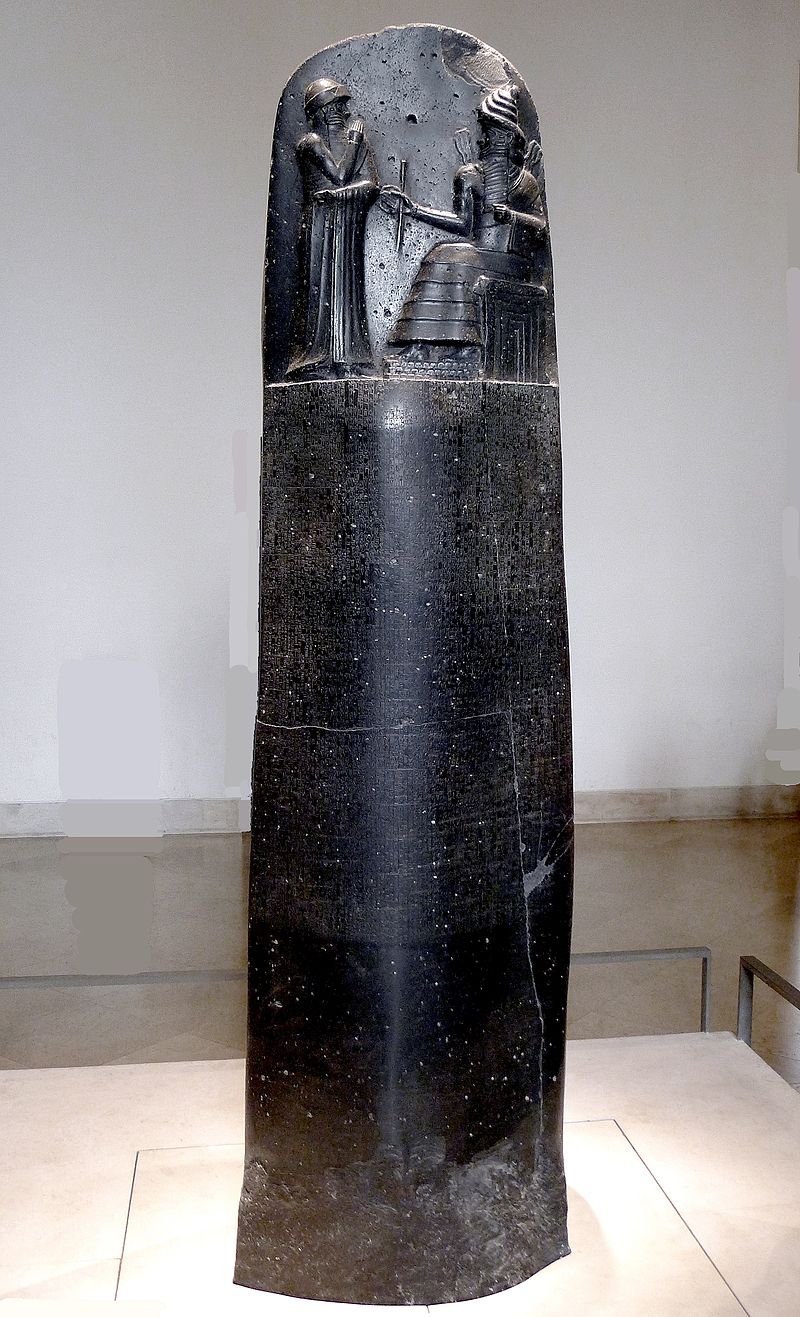
Code of Hammurabi
The Code of Hammurabi is a Babylonian legal text composed during 1755–1750 BC. It is the longest, best-organised, and best-preserved legal text from the ancient Near East. It is written in the Old Babylonian dialect of Akkadian, purportedly by Hammurabi, sixth king of the First Dynasty of Babylon. The primary copy of the text is inscribed on a basalt stele 2.25 m (7 ft 4+1⁄2 in) tall.
The stele was rediscovered in 1901 at the site of Susa in present-day Iran, where it had been taken as plunder six hundred years after its creation. The text itself was copied and studied by Mesopotamian scribes for over a millennium. The stele now resides in the Louvre Museum.
The top of the stele features an image in relief of Hammurabi with Shamash, the Babylonian sun god and god of justice. Below the relief are about 4,130 lines of cuneiform text: one fifth contains a prologue and epilogue in poetic style, while the remaining four fifths contain what are generally called the laws. In the prologue, Hammurabi claims to have been granted his rule by the gods "to prevent the strong from oppressing the weak". The laws are casuistic, expressed as "if ... then" conditional sentences. Their scope is broad, including, for example, criminal law, family law, property law, and commercial law.
Modern scholars responded to the Code with admiration at its perceived fairness and respect for the rule of law, and at the complexity of Old Babylonian society. There was also much discussion of its influence on the Mosaic Law. Scholars quickly identified lex talionis—the "eye for an eye" principle—underlying the two collections. Debate among Assyriologists has since centred around several aspects of the Code: its purpose, its underlying principles, its language, and its relation to earlier and later law collections.
Despite the uncertainty surrounding these issues, Hammurabi is regarded outside Assyriology as an important figure in the history of law and the document as a true legal code. The U.S. Capitol has a relief portrait of Hammurabi alongside those of other historic lawgivers. There are replicas of the stele in numerous institutions, including the headquarters of the United Nations in New York City and the Pergamon Museum in Berlin.
Wikipedia