Ne, Tėbai
nuorodos
Street View
nuotraukos
artefaktai
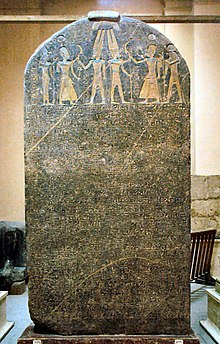
Merenptacho stela
Merneptaho stela, taip pat žinoma kaip Izraelio stela arba Merneptaho pergalės stela, yra Merneptaho, senovės Egipto faraono, kuris valdė nuo 1213 iki 1203 m. pr. Kr., užrašas. Ją 1896 m. Tėbuose atrado Flindersas Petrie ir dabar ji saugoma Egipto muziejuje Kaire.
Tekstas daugiausia pasakoja apie Merneptaho pergalę prieš senovės libius ir jų sąjungininkus, tačiau paskutinės trys iš 28 eilučių kalba apie atskirą kampaniją Kanaane, kuris tuo metu buvo Egipto imperijos dalis. Ji kartais vadinama „Izraelio stela“, nes dauguma mokslininkų 27 eilutėje esančius hieroglifus verčia kaip „Izraelis“. Buvo pasiūlyta alternatyvių vertimų, tačiau jie nėra plačiai priimti.
Ši stela yra ankstyviausia tekstinė nuoroda į Izraelį ir vienintelė nuoroda iš senovės Egipto. Tai viena iš keturių žinomų geležies amžiaus užrašų, kurie datuojami tuo laikotarpiu ir mini senovės Izraelį vardu, kiti yra Mešos stela, Tel Dano stela ir Kurko monolitai. Todėl kai kurie mano, kad Merneptaho stela yra garsiausias Petrie atradimas, su kuo sutiko ir pats Petrie.
Vikipedija
Žemėlapis
informacija iš žodyno
No
or No-A'mon, the home of Amon, the name of Thebes, the ancient capital of what is called the Middle Empire, in Upper or Southern Egypt. "The multitude of No" (Jer 46:25 ) is more correctly rendered, as in the Revised Version, "Amon of No", i.e., No, where Jupiter Amon had his temple. In (Ezek 30:14; 30:16) it is simply called "No;" but in (Ezek 30:15) the name has the Hebrew Hamon prefixed to it, "Hamon No." This prefix is probably the name simply of the god usually styled Amon or Ammon. In (Nah 3:8 ) the "populous No" of the Authorized Version is in the Revised Version correctly rendered "No-Amon."
It was the Diospolis or Thebes of the Greeks, celebrated for its hundred gates and its vast population. It stood on both sides of the Nile, and is by some supposed to have included Karnak and Luxor. In grandeur and extent it can only be compared to Nineveh. It is mentioned only in the prophecies referred to, which point to its total destruction. It was first taken by the Assyrians in the time of Sargon (Isa 20:1etc.). It was afterwards "delivered into the hand" of Nebuchadnezzar and Assurbani-pal (Jer 46:25 ; 46:26). Cambyses, king of the Persians (B.C. 525), further laid it waste by fire. Its ruin was completed (B.C. 81) by Ptolemy Lathyrus. The ruins of this city are still among the most notable in the valley of the Nile. They have formed a great storehouse of interesting historic remains for more than two thousand years.
"As I wandered day after day with ever-growing amazement amongst these relics of ancient magnificence, I felt that if all the ruins in Europe, classical, Celtic, and medieval, were brought together into one centre, they would fall far short both in extent and grandeur of those of this single Egyptian city." Manning, The Land of the Pharaohs.
EBD - Easton's Bible Dictionary