希西家王的印章
描述
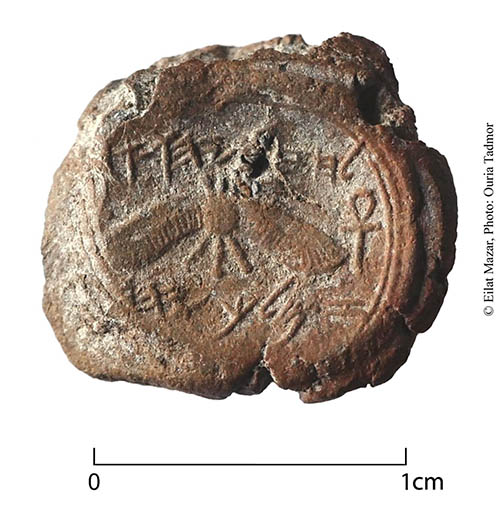
在圣经中希西家王的皇家印章在一次考古发掘中被发现。这个被称为泥封的印章是在耶路撒冷圣殿山南墙脚下的奥斐尔发掘中,由艾拉特·马扎尔博士领导的团队发现的。这个发现由耶路撒冷希伯来大学考古研究所宣布,该发掘是在其赞助下进行的。
这个泥封直径刚超过一厘米,上面有一个印章印记,描绘了一个两翼的太阳盘,旁边是生命符号,并包含希伯来文铭文,写着“属于希西家,(亚哈斯之子),犹大王。”这个泥封是在对位于奥斐尔的一个公元前10世纪皇家建筑旁的垃圾堆进行湿筛时,与其他33个印章一起被发现的。
在古代近东,泥封用于固定捆绑在卷起文件上的绳子。泥封是通过将印章按压在湿泥块上制成的。印章印记既作为签名,也作为确保文件真实性的手段。
链接
图片
地图
来自字典的信息
Hezekiah
whom Jehovah has strengthened.
Son of Ahaz (2Kings 18:1; 2Chr 29:1), whom he succeeded on the throne of the kingdom of Judah. He reigned twenty-nine years (B.C. 726-697). The history of this king is contained in (2Kings 18:20; Isa 36:1etc.; 37:1etc.; 38:1etc.; 39:1etc.), and (2Chr 29:1etc.; 30:1etc.; 31:1etc.; 32:1etc.). He is spoken of as a great and good king. In public life he followed the example of his great-granfather Uzziah. He set himself to abolish idolatry from his kingdom, and among other things which he did for this end, he destroyed the "brazen serpent," which had been removed to Jerusalem, and had become an object of idolatrous worship (Num 21:9). A great reformation was wrought in the kingdom of Judah in his day (2Kings 18:4; 2Chr 29:3-36).
On the death of Sargon and the accession of his son Sennacherib to the throne of Assyria, Hezekiah refused to pay the tribute which his father had paid, and "rebelled against the king of Assyria, and served him not," but entered into a league with Egypt (Isa 30:1etc.; 31:1etc.; 36:6-9). This led to the invasion of Judah by Sennacherib (2Kings 18:13-16), who took forty cities, and besieged Jerusalem with mounds. Hezekiah yielded to the demands of the Assyrian king, and agreed to pay him three hundred talents of silver and thirty of gold (2Kings 18:14).
But Sennacherib dealt treacherously with Hezekiah (Isa 33:1), and a second time within two years invaded his kingdom (2Kings 18:17; 2Chr 32:9; Isa 36:1etc.). This invasion issued in the destruction of Sennacherib's army. Hezekiah prayed to God, and "that night the angel of the Lord went out, and smote in the camp of the Assyrians 185,000 men." Sennacherib fled with the shattered remnant of his forces to Nineveh, where, seventeen years after, he was assassinated by his sons Adrammelech and Sharezer (2Kings 19:37). (See SENNACHERIB)
The narrative of Hezekiah's sickness and miraculous recovery is found in (2Kings 20:1; 2Chr 32:24; Isa 38:1). Various ambassadors came to congratulate him on his recovery, and among them Merodach-baladan, the viceroy of Babylon (2Chr 32:23; 2Kings 20:12). He closed his days in peace and prosperity, and was succeeded by his son Manasseh. He was buried in the "chiefest of the sepulchres of the sons of David" (2Chr 32:27-33). He had "after him none like him among all the kings of Judah, nor any that were before him" (2Kings 18:5). (See ISAIAH)
EBD - Easton's Bible Dictionary