Con dấu Hoàng gia của Ê-xê-chia
Mô tả
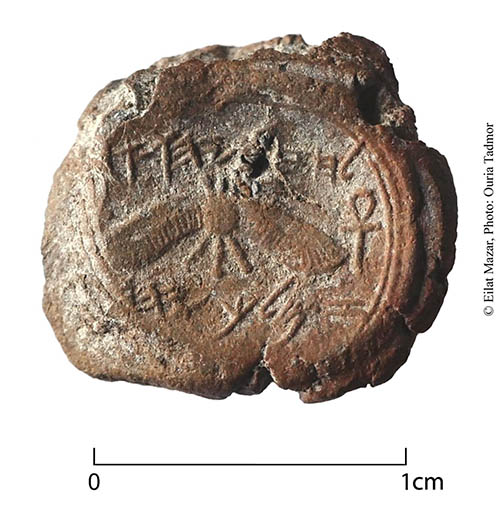
Con dấu hoàng gia của Vua Ê-xê-chia trong Kinh Thánh đã được tìm thấy trong một cuộc khai quật khảo cổ. Con dấu đất sét được đóng dấu, còn được gọi là bulla, được phát hiện trong cuộc khai quật Ophel do Tiến sĩ Eilat Mazar dẫn đầu tại chân bức tường phía nam của Núi Đền ở Jerusalem. Khám phá này đã được công bố trong một thông cáo báo chí của Viện Khảo cổ học Đại học Hebrew của Jerusalem, dưới sự bảo trợ của họ mà các cuộc khai quật đã được thực hiện.
Bulla, có đường kính chỉ hơn một centimet, mang một dấu ấn con dấu mô tả một đĩa mặt trời hai cánh được kèm theo các biểu tượng ankh và chứa một dòng chữ tiếng Hebrew ghi "Thuộc về Ê-xê-chia, (con của) A-cha, vua của Giu-đa." Bulla được phát hiện cùng với 33 bulla khác được đóng dấu trong quá trình sàng lọc ướt đất từ một bãi rác nằm cạnh một tòa nhà hoàng gia thế kỷ 10 TCN ở Ophel.
Ở Cận Đông cổ đại, bulla đất sét được sử dụng để bảo đảm các dây buộc quanh các tài liệu cuộn lại. Các bulla được tạo ra bằng cách ấn một con dấu lên một cục đất sét ướt. Bulla được đóng dấu phục vụ như cả một chữ ký và như một phương tiện đảm bảo tính xác thực của các tài liệu.
liên kết
hình ảnh
Bản đồ
thông tin từ từ điển
Hezekiah
whom Jehovah has strengthened.
Son of Ahaz (2Kings 18:1; 2Chr 29:1), whom he succeeded on the throne of the kingdom of Judah. He reigned twenty-nine years (B.C. 726-697). The history of this king is contained in (2Kings 18:20; Isa 36:1etc.; 37:1etc.; 38:1etc.; 39:1etc.), and (2Chr 29:1etc.; 30:1etc.; 31:1etc.; 32:1etc.). He is spoken of as a great and good king. In public life he followed the example of his great-granfather Uzziah. He set himself to abolish idolatry from his kingdom, and among other things which he did for this end, he destroyed the "brazen serpent," which had been removed to Jerusalem, and had become an object of idolatrous worship (Num 21:9). A great reformation was wrought in the kingdom of Judah in his day (2Kings 18:4; 2Chr 29:3-36).
On the death of Sargon and the accession of his son Sennacherib to the throne of Assyria, Hezekiah refused to pay the tribute which his father had paid, and "rebelled against the king of Assyria, and served him not," but entered into a league with Egypt (Isa 30:1etc.; 31:1etc.; 36:6-9). This led to the invasion of Judah by Sennacherib (2Kings 18:13-16), who took forty cities, and besieged Jerusalem with mounds. Hezekiah yielded to the demands of the Assyrian king, and agreed to pay him three hundred talents of silver and thirty of gold (2Kings 18:14).
But Sennacherib dealt treacherously with Hezekiah (Isa 33:1), and a second time within two years invaded his kingdom (2Kings 18:17; 2Chr 32:9; Isa 36:1etc.). This invasion issued in the destruction of Sennacherib's army. Hezekiah prayed to God, and "that night the angel of the Lord went out, and smote in the camp of the Assyrians 185,000 men." Sennacherib fled with the shattered remnant of his forces to Nineveh, where, seventeen years after, he was assassinated by his sons Adrammelech and Sharezer (2Kings 19:37). (See SENNACHERIB)
The narrative of Hezekiah's sickness and miraculous recovery is found in (2Kings 20:1; 2Chr 32:24; Isa 38:1). Various ambassadors came to congratulate him on his recovery, and among them Merodach-baladan, the viceroy of Babylon (2Chr 32:23; 2Kings 20:12). He closed his days in peace and prosperity, and was succeeded by his son Manasseh. He was buried in the "chiefest of the sepulchres of the sons of David" (2Chr 32:27-33). He had "after him none like him among all the kings of Judah, nor any that were before him" (2Kings 18:5). (See ISAIAH)
EBD - Easton's Bible Dictionary